

Reflections on a Day
I have been participating in Russia's Victory Day celebration for four years now. This one hit differently.
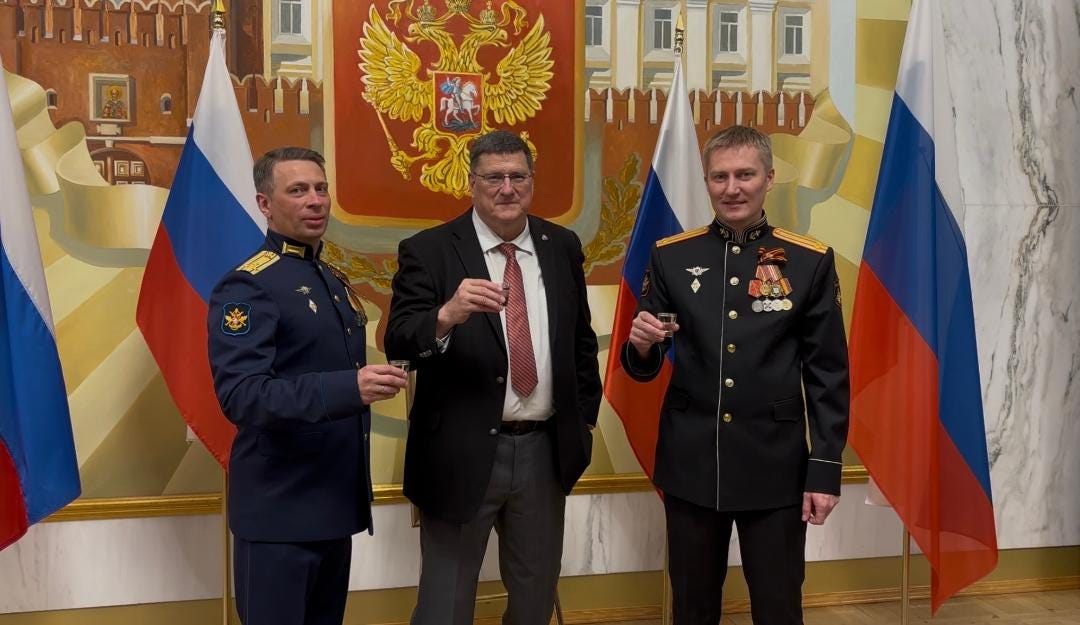
I’ve been directly involved with celebrating Victory Day for the past four years. In 2023 I had the honor and privilege of being in the audience for the live full dress rehearsal of the Victory Day parade in Moscow on May 7, and to see first hand how the citizens of Russia throughout the Russian Federation approached this most sacred day and celebrated their most venerated history—the victory over Nazi Germany.
In 2024, 2025 and again this year, I have had the honor and privilege of being an invited guest to the Russian Embassy in Washington DC, where I have had the pleasure of the company of Russian diplomats and military officers from the Russian Defense Attache’s Office as we marked the occasion of our joint victory over German fascism.
Victory Day is simultaneously a sobering and uplifting experience—sobering because one is marking the end of a conflict that consumed the lives of 27 million Soviet citizens—19 million of whom were from the Russian Soviet Federative Socialist Republic, which today comprises the Russian Federation, and uplifting because this victory came only due to the patriotic sacrifice of the soldiers, workers and citizens of the Soviet collective, namely the grandfathers and grandmothers (or great-grandfathers and great-grandmothers) of the celebrants, all of who recognize the reality that they would not be alive today if it weren’t for these heroes, almost all of whom have passed since the fall of Berlin in May 1945.
Never forgetting the sacrifice of the heroes, and never forgiving the sins of the Nazis, is the very essence of Victory Day.
Twenty-seven million pairs of eyes stare down from the heavens on those who are alive today, a constant reminder of the sacrifice they made, and the necessity of those who live to never forget the past, and always strive to preserve what the dead gave their lives to defend.
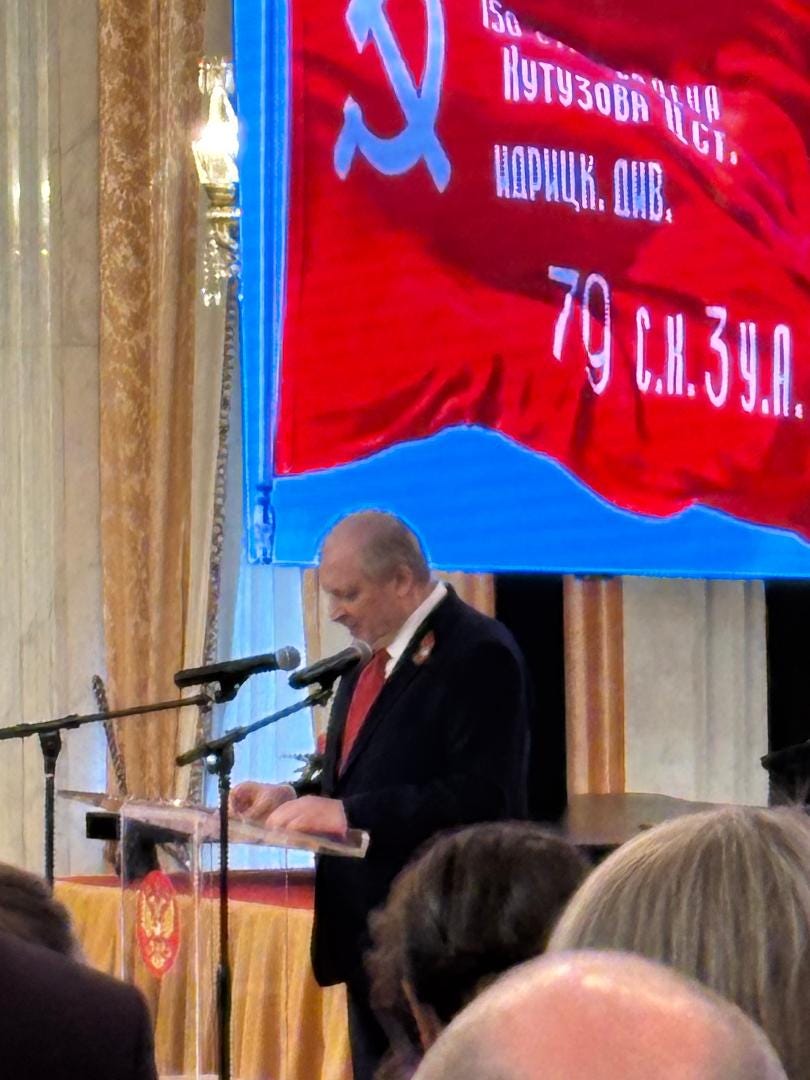
The Victory Day celebration is not only a national holiday in Russia, but a national event of great importance. Interviews are given. Articles are written. Speeches are made. Press conferences are held. Victory Day 2026 proved to be no exception.
On May 6 Sergei Karaganov, an influential Russian political scientist who heads the Council for Foreign and Defense Policy considered close to both Russian President Vladimir Putin and Russian Foreign Minister Sergei Lavrov, gave an interview to Yuliya Novitskaya, a journalist with New Eastern Outlook, an internet journal published by the Institute of Oriental Studies of the Russian Academy of Sciences. “Europe,” Karaganov declares, “is the most vile civilization in human history, the spawn of all terrible wars. Moreover, Karaganov notes, Europe “is returning to its old ways; revanchism is emerging from it.”
Karaganov continues: “If the Europeans continue to wage war against us (and we are waging war against Europe, and Europe is waging war against us, even though we shyly avoid saying so), then we will need to move to real actions – and not regarding Ukraine. For many years, Ukraine was being turned into a dagger aimed at Russia’s chest. We did not want to admit that. We were foolish and weak. Now that unfortunate, brainwashed, and partially fraternal people are in the state they are in. But the root of evil is in the West. Therefore, we will need to strike the West.”
The consequences of such action, Karaganov states, will be dire. “They [Europe] must know that they will be destroyed first. And we, unfortunately, must instill terror in them. This is the only way – animalistic terror – to avoid a long, exhausting war for ourselves and, for humanity, to avoid sliding into a third world general thermonuclear war, which has already begun.”
Karaganov’s words did not appear in a vacuum. On May 7 Dmitry Medvedev, the former Russian President and Prime Minister, and current Deputy Chairman of the Security Council of the Russian Federation, published a provocative article in RT entitled “Germany’s New Militarism” where he lambasted the reimagination of history by the German people who, far from posturing as the progeny of the greatest mass murderers in modern European history, instead see themselves as being “undeservedly and cruelly wronged after World War II.” Medvedev warned of the emergence of a new militarism, inclusive of visions of Germany as a nuclear power, and cautions that the consequence of this madness would be the “end of European civilization.”
Like Karaganov, Medvedev advocated for decisive action by Russia. “We are dealing with an irreconcilable, desperate, and insane enemy,” he noted, “who must either be pushed back or destroyed.”
For three years I have listened to Russian Ambassadors deliver speeches at the Victory Day receptions they host at their Embassy in Washington, DC. Anatoly Antonov delivered one in 2024, and Alexander Darchiev delivered the next two, in 2025 and 2026.
The first two speeches were deemed to be derived from the normal diplomatic playbook, promoting the shared history of the US and Russia in defeating Nazi Germany, and lamenting the conflict in Ukraine as an historical anomaly which could be resolved with negotiations centered on the notion of generating a lasting peace, not just a cessation of hostilities.
This year the aura was darker. While the Ambassador held out the olive branch of peace to the United States, noting a new attitude in Washington DC regarding Russia that could lead to positive outcomes if adequately followed through, Ambassador Darchiev also made a direct link between Ukraine and Nazi Germany, emphasizing the notion of “unconditional surrender” when it came to settling the fate of Ukraine. Moreover, the Ambassador focused much of his attention on the role of Germany today, clearly drawing a link between Germany’s Nazi past and the government today. Accompanying video clips the Ambassador used to illustrate his speech underscored this linkage, focusing as they did on Hitler’s demise, Germany’s defeat, and Russia’s demands for unconditional surrender.
Russian President Vladimir Putin delivered a speech of his own during the Victory Day parade in Moscow. Looking out among the massed ranks of the assembled troops, Putin declared that as he and other Russians celebrated this day, “we feel pride and love for our country, we understand our common duty to protect the interests and the future of our Motherland, and we are sincerely thankful to the great generation of victors.”
When speaking about the ongoing conflict in Ukraine, President Putin stated that “The great feat of the victorious generation inspires the soldiers carrying out the tasks of the special military operation today. They are confronting an aggressive force armed and supported by the entire NATO bloc. Despite this, our heroes are advancing.”
Alongside Russian soldiers are workers, designers, engineers, scientists and inventors. They continue the traditions of their predecessors, and drawing on modern combat experience, create advanced and unique models of weapons, and launch their mass production.
But no matter how the equipment and methods of warfare change, one thing remains unchanged: the fate of the country is determined by its people – soldiers and factory workers, agricultural laborers, weapons designers and war correspondents, doctors and teachers, cultural figures and clergy, volunteers, entrepreneurs and philanthropists. All citizens of Russia.
Putin continued on the theme of the conflict with Ukraine in comments made during a press conference after the parade, declaring that “the Armed Forces [of Russia] should focus on the decisive defeat of the enemy within the framework of the special military operation.”
Speaking about those nations which supported Ukraine in its fight against Russia, Putin stated that “everyone expected Russia to collapse quickly. In their view, within six months everything would have supposedly fallen apart: businesses would have stopped functioning, the banking system would have failed, and millions of people would have lost their livelihoods.”
This did not happen. Despite this thwarted objective, Putin continued to leave the door to peaceful relations with Europe open. “We have always tried to build relations with Europe,” Putin said, “on the basis of mutual respect and consideration of each other’s interests. These are not merely diplomatic clichés – that is genuinely how we approached our relations. Even now, not everyone speaks to Europe in that manner, but we always did. Yet apparently that was not enough.”
Unlike Karaganov and Medvedev, Putin concluded his remarks on a somewhat positive note, stating that “I hope that relations will eventually be restored with many of the countries that are currently attempting to denounce us. The sooner that happens, the better it will be for us and, in this case, for the European countries.”
But everything was not honey and roses. The 2026 Victory Day celebration was conducted under the cloud of threatened Ukrainian drone attacks. In response, Russia for the first time put the Ukrainian government on notice that any attack on Moscow during the Victory Day celebration would result in a massive missile bombardment on Kiev which would target the so-called “decision making” centers of Ukraine—including the Parliament and the offices of government, including the Presidential Administration buildings on Bankova Street.
This was the first time Russia had ever made such a direct threat, signally a growing Russian frustration with the pack of action on the frontline.
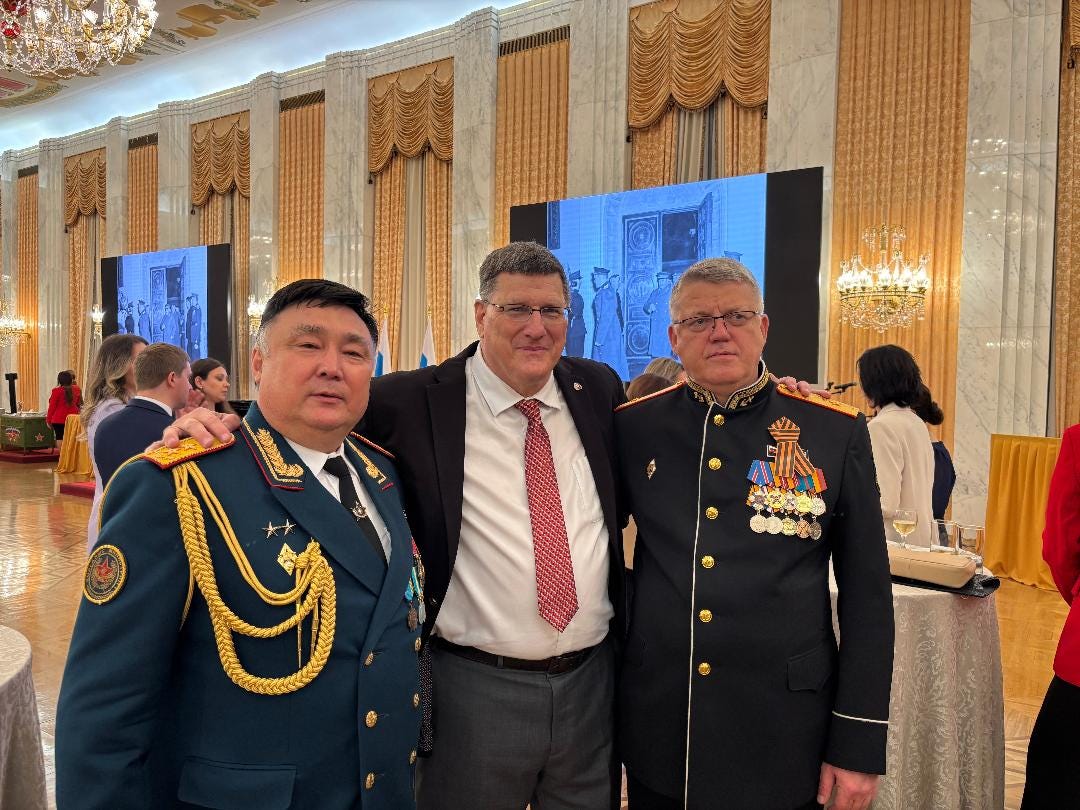
When I was an intelligence officer in training, we were schooled on the various sources and methods available to us when building an intelligence collection management plan designed to answer the various policy and operational questions we could be expected to have to answer during the course of our career. While we received a cursory lesson on the role played by the defense attaché’s office (DAO), we were too junior to understand the important role that the so-called “cocktail circuit” (the seemingly never-ending receptions and events put on by the various embassies in a nation’s capitol played in collecting information of interest. We would often have to be schooled as to the inadequacy of whatever plan we developed because we neglected the value of serendipitous (and, admittedly, targeted) conversation that takes place at such functions.
Over the years I have developed a bond of friendship with the Russian officers of the Russian Defense Attaché Office attached to the Russian Embassy in Washington, DC. I attend the various functions where our paths cross as a private citizen functioning in the role of independent journalist and analysts, and conduct myself accordingly. But I have publicly questioned the wisdom of the US State Department in banning the participation of US military officers and diplomats from these events. The conversations are fascinating, touching upon a broad range of topics, and the people you meet are full of information and insights which, had I been a US military officer working in an official capacity, would have made it into any number of reports that would be used to better inform US policy makers about Russia and Russian affairs.
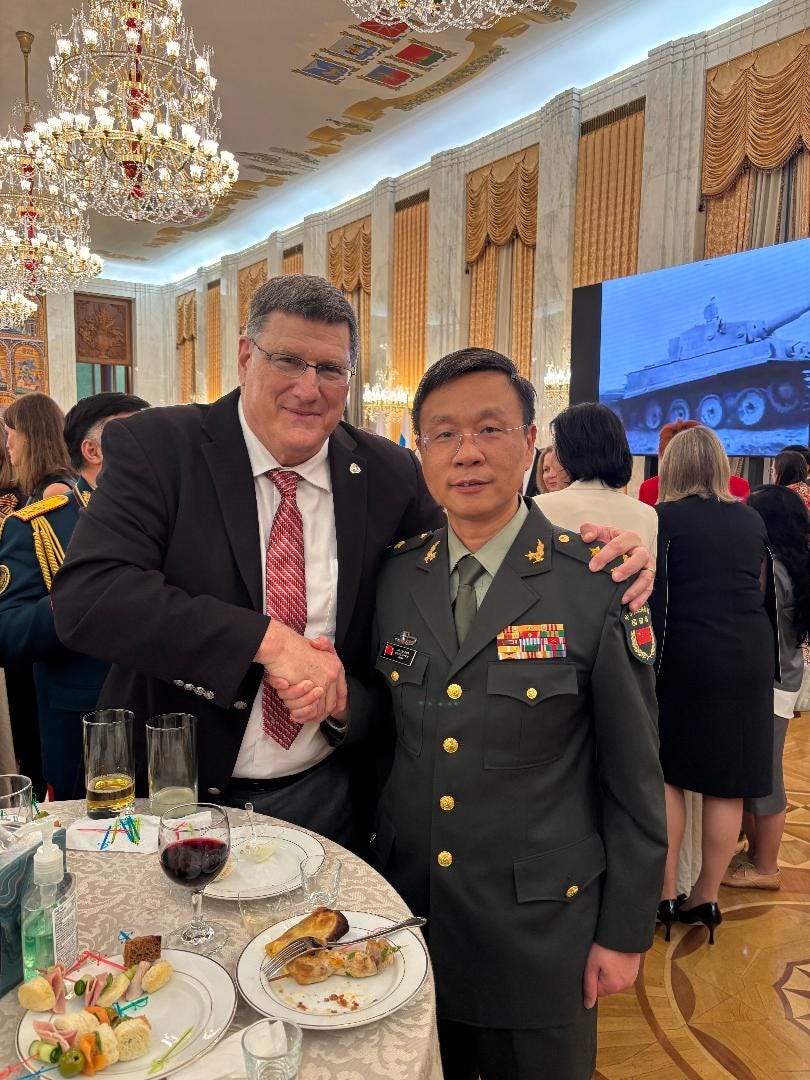
One of the more insightful observations I made during the most recent Victory Day celebration was the active participation of the Chinese defense attaché's in the post-speech celebrations—that moment when the military officers close circle and celebrate amongst themselves with stories and conversations peppered with vodka-enhanced toasts.
The Chinese officers have always been present in the past, but always melted away once the formal phase of the proceedings were finished. This year they stayed for the informal celebrations, and joined the Russian officers for toasts and comradeship. For the first time in my direct experience, the narrative of the sacrifice of the Soviet people at the hands of the Nazis was placed on the same level as the sacrifice of the Chinese people at the hands of Imperial Japan (27 million and 40 million, respectively.) Victory Day, at least as how it was marked that evening, was broadened to take into consideration the Chinese experience, and toasts were made to mark their shared histories.
As an analyst, one seeks to avoid reading too much into words and events without first establishing a clear linkage that enables sound comprehensive assessments. It is too early to draw a direct relationship between Sergei Karaganov’s threatening posture and the toasts of Chinese-Russian friendship, or to link Dmitry Medvedev’s ominous writings with the words of President Putin. But what I can say is this: this year’s Victory Day celebration was unlike any I had experienced in the past. It was darker in tone and content, and signified a greater commitment to total victory over Russia’s enemies than there had been in previous years, where the possibility of a diplomatic solution dominated the narratives being bandied about. I think were are looking at a summer full of decisive action designed to bring the Russian Special Military Operation in Ukraine to a conclusion acceptable to Russia, and Ukraine’s supporters in Europe be damned.
(The disease of Russophobia is the root cause of much of the policies embraced by the collective west in pursuing their aggressive proxy-war against Russia. The antidote to Russophobia is fact-based truth. This kind of truth is best discerned through first-hand observations of the sort which constituted the foundation of this article. I will shortly be returning to Russia to continue carrying out journalistic work designed to capture first-hand information and bring it back to a western audience. This trip, and others like it, are made possible only through the generous donations of subscribers and supporters. I thank everyone who has supported my work to date, and ask for help going forward so this work can continue.)
Thank you, Major Ritter (retired) for having the courage to break through the western propaganda barrier and tell it like it is. You are a true diplomat 🫡
I just watched this interview by Glen Diesen with Karaganov. He doesn’t mince his words…
https://youtu.be/2Gd5jdl36cg?si=X4K35TUh4Ss5MWhG
"Going for Broke"
America's network of military bases around the world is a relic of the 20th Century. They were established in the wake of World War 2, then sustained and expanded as a result of the Cold War and its aftermath.
Keeping with the global interest in multipolarity and the emerging economic power of the Global South through BRICS, most of these bases may now be unnecessary and increasingly irrelevant.
China's development model seeks mutual economic benefits with other countries, but without the kind of military and political control that the US has insisted upon since the last century.
Thus, the remainder of the 21st Century may see the US make a mad dash for total domination of the world, or be forced to accept a humiliating retreat from many of the countries in which it has based its military forces.