

Back to the Future
Maybe the only way to reset US-Russian relations is to go back to the Cold War and start all over again.

Donald Trump twice ran for President on a platform which included his desire to make normalizing relations with Russia a top priority. “Wouldn’t it be nice if we got along with Russia?” Trump famously said during his 2016 Presidential campaign. “I have a very good relationship with President Putin,” Trump said in September 2024.
But things didn’t work out as planned. “There’s never been a president as tough on Russia as I have been,”, Trump said in July 2018, reflecting the reality of his administrations Russian policy—stringent economic sanctions and military support for Ukraine topping the list of his accomplishments vis-à-vis Moscow.
“I’ve always had a very good relationship with Vladimir Putin of Russia, but something has happened to him,” Trump declared in May 2025. “He has gone absolutely CRAZY! I’ve always said that he wants ALL of Ukraine, not just a piece of it, and maybe that’s proving to be right, but if he does, it will lead to the downfall of Russia!”
The yin and the yang of Trump’s on again, off again bromance with Russian President Vladimir Putin has created confusion in the ranks of Trump watchers for some time now.
But the reality is even Trump doesn’t know what he wants with Russia, because his statements aren’t derived from any personal commitment to either Russia or its leader regarding the betterment of relations, but rather are symptomatic of a man (Trump) who has a history of saying anything, not matter how far-fetched, unrealistic and fact challenged, in order to get what he (Trump) wants.
Trump isn’t looking to have a genuine friendship with either Putin or Russia, but rather to have Putin, as the leader of Russia, to do Trump’s bidding.
In short, Trump wants a US-Russian relationship that sustains the decades-long goal of the United States since the Cold War ended in 1991 to keep Russia weak and completely subordinated to the will of the United States.
In this, Trump is no different that Bill Clinton, George W. Bush, Barack Obama, and Joe Biden—all former Presidents who pursued policies deigned to weaken and subjugate Russia and—perhaps most importantly—to undermine and diminish the ability of Vladimir Putin to function as President of Russia.
There are two things all of these leaders have in common when it comes to Russia. First and foremost is the belief that the United States won the Cold War, which creates a psychological profile of a defeated Russia that helps shape a consistent policy prerogative that places the US in a superior roll when envisioning any US-Russian relationship.
Second is the undying bitterness and resentment toward Russian President Vladimir Putin for playing along with the script as written by the American victors, opting instead to raise Russia to its feet, and instill it with national pride that postures Russia as the equal to the United States.
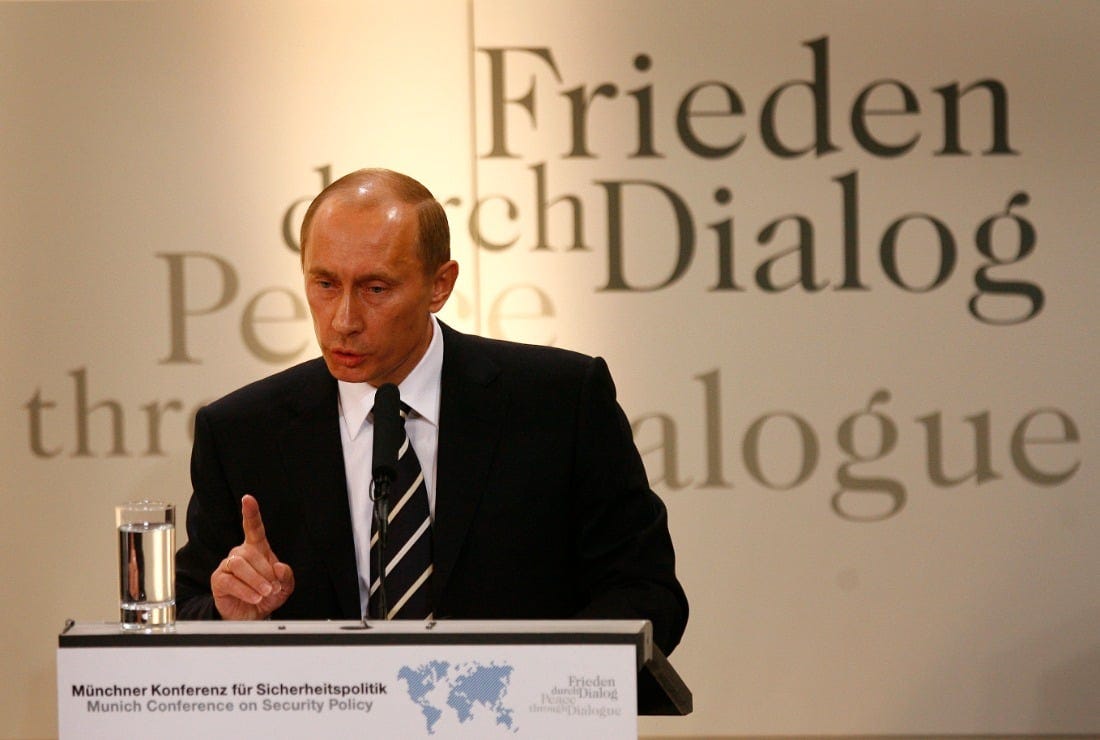
Putin’s famous declaration of independence, delivered at the Munich Security Conference in 2007, sent shock waves through an American establishment elite thoroughly infected with Russophobia, and who expected Putin to resume the role played by Russia’s first President, Boris Yeltsin, by prostrating himself at the feet of the American victor and Russia’s true savior.
The 2009 “reset” of relations orchestrated by Barack Obama was little more than a regime change operation disguised as diplomacy, where the US sought to replace Vladimir Putin with Dmitri Medvedev in hopes that Medvedev would prove to be more compliant. Dmitri Medvedev’s current X account is proof positive that the Obama administration did not have a good read on the former Russian President, or Russia as a whole.
Russia will never willingly return to the conditions that created the debacle of the 1990’s.
Russia will never again subordinate its national pride, culture, security and history to the whims of the West.
And yet this is precisely what Donald Trump is seeking today. It is literally “my way or the highway”, and the “highway” Trump speaks of is an off-ramp to hell.
Trump’s policy towards Russia has never significantly detoured from the strategic course that had been in place since the Cold War ended.
Keeping Russia weak by promoting the independence of Ukraine, and encouraging Ukrainian integration into western economic and military relationships, has been a consistent theme since 1991, and very much remains in effect today.
And controlling Russia’s economy—and, through this vector, its very existence—is the core component of Trump’s Russia policy. The goal of Trump’s sanctions policy is to “collapse” the Russian economy, which means to collapse Russian society and with it Russia’s political system.
The economic relationship Trump envisions with a post-conflict Russia is like that which he promotes with Ukraine—heavy American involvement in core businesses as a means of exerting control overt the policies of the relevant economic “partners.”
With Ukraine, this is called “security guarantees.”
With Russia, its simply economic surrender.
The “Spirit of Alaska” which has been promoted by both Russian and American officials since the summit meeting this past August between Trump and Putin is nothing more than a subterfuge, and wolf in sheep’s clothing that disguises the true policy objectives of the Trump administration when it comes to Russia.
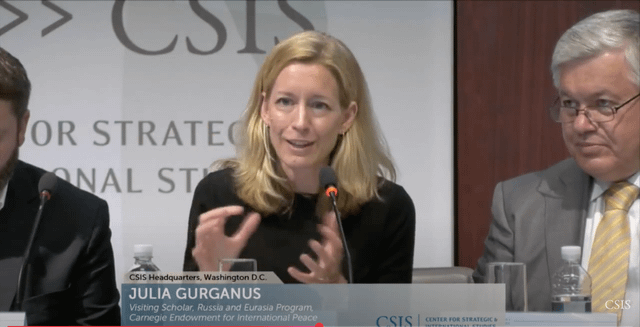
It’s a little known fact that Julia Gurganus, a former senior CIA Russia analyst who, back in 2016-17, served as the National Intelligence Officer for Russia and Eurasian Affairs and, in this role, was responsible for overseeing the production of a controversial Intelligence Community Assessment (ICA) that claimed Russia colluded with Donald Trump to steal the 2016 Presidential election, was on Air Force One as Trump flew to Alaska.
The mission of this infamous Russophobe wasn’t to brief the President on the possibilities for better relations between the US and Russia, but rather how the President could use the Alaska Summit to box President Putin in and create the possibility of collapsing the Russian government in the process.
Gurganus was on Air Force One thanks to the intervention of her boss, CIA Director John Radcliff. Radcliff had gone out of his way to whitewash Gurganus’ past sins, declassifying a report in May 2025 that cleared Gurganus of all wrongdoing regarding the 2017 ICA (unfortunately for Gurganus, Director of National Intelligence Tulsi Gabbard carried out a more detailed and honest investigation that found Gurganus culpable, resulting in her security clearances being terminated along with her employment at CIA. But this came after the Air Force One briefing.)
Gurganus’ job wasn’t to help coach Preisent Trump through the political machinations of normalizing relations with the Russian President.
It couldn’t be, for the simple fact that she worked for John Radcliff, and his job was to strategically defeat Russia and bring down the government of Vladimir Putin.
That was the mission he was given by President Trump.
Radcliff and his paramilitary operatives from the CIA’s Special Activities Group had been working hand in glove with the Ukrainian intelligence services and special forces to plan and execute strategic strikes deep inside Russia. They were closely involved in “Operation Spiderweb”, the Ukrainian drone attack on Russian strategic bombers carried out in June 2025. And the CIA publicly flaunted its role in facilitating Ukrainian drone attacks on Russian oil refining infrastructure.
But the biggest “tell” that the CIA and Trump were not interested in peace with Russia, but rather were using the search for a peaceful solution to the Russian-Ukrainian conflict as a cover for regime change inside Russia, was the December 29, 2025 Ukrainian drone attack on Vladimir Putin’s personal residence in the Novgorod region of Russia, executed while Putin was in telephonic discussions with Donald Trump about ending the war in Ukraine.
At first Trump feigned dismay and anger. But later he called the Russian version of events lies and accused Vladmir Putin of making things up.
The problem for Trump was that the failed attack left a body of debris in its wake that included intact computer guidance components which contained the precise coordinates of the intended target (yes, Putin’s residence) as well as data on the route to be flown by the drone.
American digital “fingerprints” were all over this guidance component, something the Russians knew when their head of military intelligence handed one of these intact components over to the US military attaches in Moscow.
Russia knows the truth.
And the truth is that the United States under Donald Trump still seeks the strategic defeat of Russia.
Nothing has changed from the policies of Joe Biden.
Of Barack Obama.
Of Donald Trump’s first term.
Next month the New START treaty expires. It is the last remaining arms control treaty between the US and Russia and has its roots in the legacy of Cold War-era arms control. Russian President Vladimir Putin has indicated his readiness to implement a one-year moratorium regarding the “caps” mandated under New START that limit the number of deployed strategic nuclear weapons for each party to the treaty at 1,550.
While Trump initially indicated support for the extension of New START, more recently he expressed indifference to the fate of the treaty, claiming he could negotiate a better one.
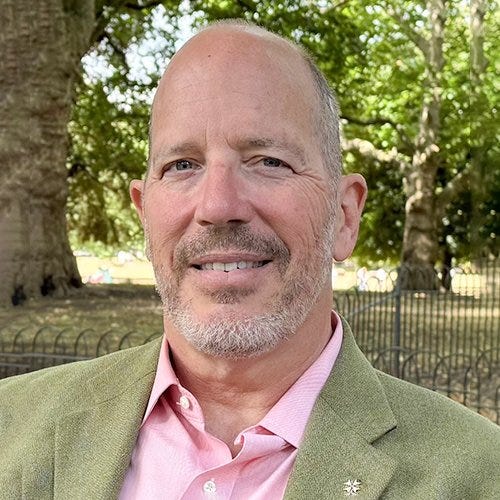
Here we must take note of the words and deeds of Christopher Ford, the former US Assistant Secretary of State for International Security and Nonproliferation, and Under Secretary for Arms Control and International Security, during Donald Trump’s first term.
Christopher Ford was responsible for overseeing arms control issues between the US and Russia.
Christopher Ford helped kill the INF treaty in 2019.
Christopher Ford strongly believes that arms control is only useful in so far as it solidifies a US strategic advantage over the Russians.
Christopher Ford is the face of post-Cold War arms control reality.
In short, Christopher Ford and people who think like Christopher Ford believe that an arms race with Russia is better than genuine arms control.
Which is why we are headed toward an arms race with Russia and are witnessing the death of arms control.
The question facing the US and Russia today is what is there to be gained by pushing agendas which lead to different outcomes?
The US demands that Russia yield.
And Russia will not yield.
It is said that we are on the cusp of a new Cold War.
Why not just embrace this outcome?
Yes, the Cold War brought us to the brink of nuclear war.
John F. Kennedy said of the Cuban Missile Crisis of October 1962 that there was a 30% chance of a nuclear war between the US and the Soviet Union at that time.
John F. Kennedy did not want to fight a nuclear war with the Soviet Union, so we avoided one.
In November 2024 select members of Congress were briefed by the CIA that there was a greater than 51% that there would be a nuclear war between Russia and the US before the year ended.
And the Biden administration said they were ok with that, and they were prepared to win such a war.
Only Donald Trump’s election took us off that path.
And Donald Trump just tried to kill the President of Russia.
The Cold War is looking pretty good by comparison.
The Cold War has been made out as an existential struggle between two competing, inherently incompatible ideologies.
But the reality was far different.
During the Cold War the US and Russia had extensive diplomatic relations.
Tourism was possible and encouraged.
There were cultural exchanges between our two nations.
Academia specialized in Russian area studies that educated students on the reality of Russia.
In short, our two nations respected each other, in large part because we feared each other. We knew that any concerted effort to strategically defeat the other side would result in nuclear driven mutually assured destruction.
The Cold War enabled the process of meaningful arms control to begin; a process predicated on mutual respect and the need for mutual trustworthiness.
But the Cold War wasn’t so much triggered by differing ideologies as it was born of the Soviet rejection of submitting to American economic hegemony.
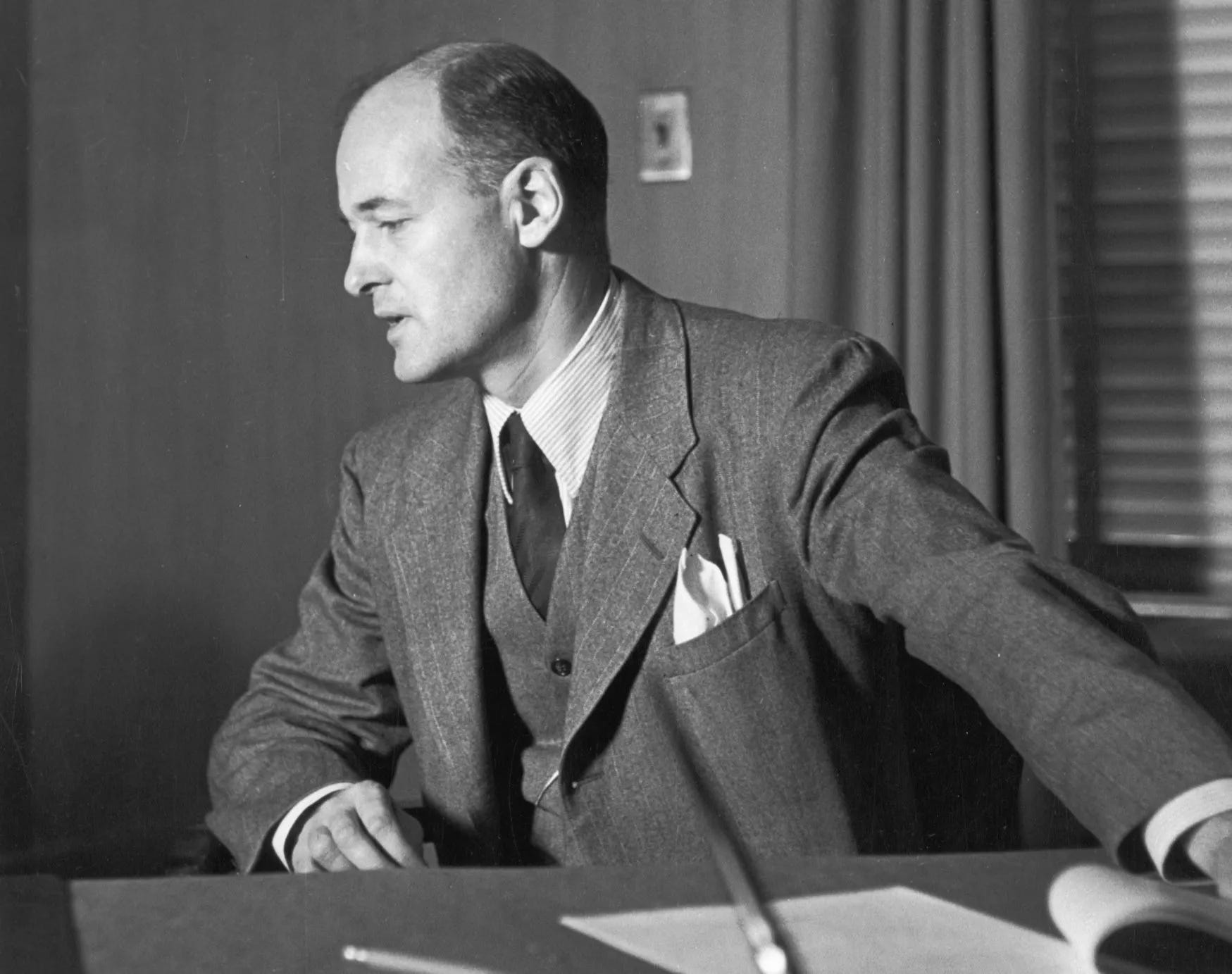
Most Cold War historians point to George Kennan’s February 1946 “Long Telegram” as beginning the process that led to the Cold War. Kennan’s missive painted a picture of a Soviet Union at fundamental odds with the policies and priorities of the West. This telegram set into motion what became known as the “Truman Doctrine” announced by President Harry S. Truman in 1947. The “Truman Doctrine” committed America to communism by providing financial and military aid to countries like Greece and Turkey threatened by Soviet expansion. It established the containment of the Soviet Union as a cornerstone of US policy. These ideas were later weaponized in the form of NSC-68, a 58-page top secret document which formally laid out the US goal of containing Soviet power and communist ideology.
Kennan later said that his long telegram was not intended to create the ideological foundation of the Cold War, and that the fact that it was used in this manner was largely due to the misreading of the intent behind the communication.
The genesis for the Long Telegram wasn’t grounded in concern over Soviet power or communist ideology, per se, but rather an inquiry from the Department of Treasury as to why the Soviet Union was resistant the joining the World Bank and the International Monetary Fund.
Joseph Stalin, it seemed, wasn’t keen on having the Soviet Union’s economy taken prisoner by what would grow to become the “rules based international order.”
The inherent incompatibility of the US and Soviet economic systems was the real root cause of the Cold War.
There is a myth that has gained popularity in the West that holds that the United States defeated the Soviet Union in the Cold War by forcing the Soviets to bankrupt itself by engaging in an arms race with the United States.
But the facts don’t align with the myth.
The Soviet economy, by most accounts, had by the late 1970’s-early 1980’s entered a phase of relative stagnation when it came to basic consumer goods.
This much is true.
But the Soviet economy functioned.
Most Soviet citizens who were alive during this time think fondly of Soviet society, because it was not, as the West portrays, a society in decline.
The defeat of the Soviet Union came not from outside forces, but rather internal forces. The misrule of Mikhail Gorbachev, hailed as a “reformer” by the West, is widely seen as the genesis of the collapse of the Soviet Union.
Gorbachev’s desire to transform the Soviet economy into a western-style consumer economy went against the very grain of the policy direction undertaken by Stalin in 1946, namely, to avoid being consumed by western economic organizations and systems, because to do so would mean the end of Soviet sovereignty.
Gorbachev disregarded this fundamental principle, opened the Soviet Union up to western economic ideas that were then imperfectly implemented, and the rest is history.
But the notion that the West “defeated” the Soviet Union simply isn’t supported by the facts.
The realities of the Cold War produced détente.
The realities of the Cold War produced real arms control that first sought to end an arms race by limiting the growth of the respective nuclear arsenals of the US and Soviet Union, then to reduce them, with the goal (expressed in 1986) of eliminating nuclear weapons altogether.
The realities of the Cold War allowed Ronald Reagan, a staunch conservative, to stop calling the Soviet Union ”the Evil Empire”, and concede that our two nations could be friends.
Because we respected each other.
Because we trusted one another.
Today the reality is that the US does not respect Russia and will not so long as the mythology of a US Cold War “victory” is ended.
And given the behavior of the United States over the course of the three decades that have passed since the end of the Cold War, there can be no possibility of trust existing on the part of Russia so long as the US believes it won the Cold War and pursues policies contingent upon Russia’s concession of its defeat and subsequent subjugation.
We need a reset.
Its time to go back to the future, replicating Marty McFly’s experiences in the movie “Back to the Future”, where he goes back in time to change the outcomes that manifest themselves in the present.
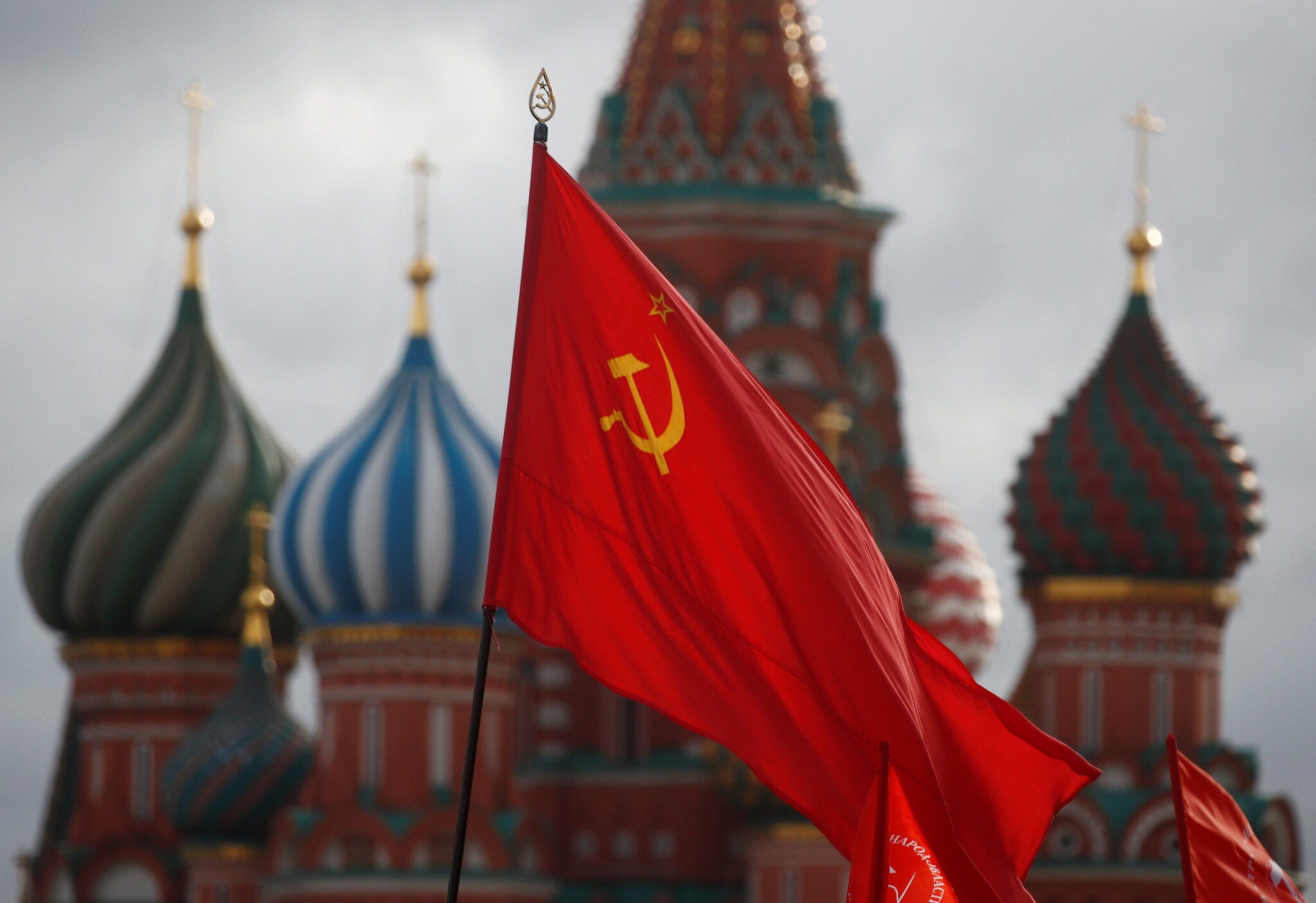
A New Cold War accepts as necessary a new nuclear arms race, because only by resurrecting the fear of nuclear annihilation will the United States ever engage in meaningful arms control predicated on mutually beneficial outcomes as opposed to the unilateral advantages the US seeks to accrue and sustain today.
A New Cold War would necessitate diplomatic engagement, which means academic institutions would need to adjust to the need for genuine Russian experts, and not the anti-Putin ideologues that are currently being produced.
A New Cold War would result in mainstream media altering its coverage of Russia, if for no other reason that their master’s in government would need to focus on real solutions to real problems, and not pretend solutions to manufactured problems.
A New Cold War would compel the United States to reprogram its entire approach toward Russia, purging from its policies the notion of the necessity to sustain Russia as a defeated, subjugated nation, and instead recognizing Russia as an equal, possessing powerful traits, inclusive of a unique and important civilization.
A New Cold War would mandate the end of irrational Russophobia, if for no other reason than the US would become compelled to know the reality of this new adversary.
It is time to drive a stake through the heart of the failed post-Cold War policies of the US when it comes to Russia. The US must be completely reeducated about the Russian reality. This is impossible in the current ideologically driven political climate.
This can only happen if we go back in time, resurrect the Cold War, and then seek a different outcome.
One where our two nations agree to occupy the world we live in as equals, and forever dispensing with both the notion of Russia as a defeated nation, and the need for a winner and a loser when it comes to US-Russian relation.
We must learn to live together in peace as equals.
Or else die together as enemies.
This is an existential problem that can only be addressed in a Cold War environment.
We need a New Cold War if we are going to have a chance at survival.
Because the current state of US-Russian relations has us on a one-way trip on a highway to hell.
Scott, just taking the opportunity to thank you for your work, and salute you for your integrity and courage, in which i believe your wife must be included. As a South African, my disappointment at the behaviour of the current US regime, with its puerile war department and thoughtless partriarchal defense of misogynistic pseudo men, veers to the extreme, and is only effectively redirected by Americans such as yourself, Garland Nixon, and the magnificent Golden judge, to mention Shakespeare's noble few, and its reassuring to reflect that the current abusers of power do not represent a significant majority, so the situation is not hopeless, and Mark Twain and Walt Whitman may soon be able to rest easily in their graves again, thanks to people of your calibre, that to me constitute the real America, and keep me soberly optimistic.
( ps the privations that the governing regime bullies you with fills me with dismay and deep comisseration with you and your marvellous spouse, but isn't that the type of thing we should expect when the head is rotten and dispensing disease downwards?)
Scott you are an international treasure. Thank-you for daily sacrifice of hours of interviews, speaking, writing, and research. Is there a GoFundMe set-up for your family so any nation can donate to you while you are de-banked?
Canada stole the million$ donated for the Freedom Convoy in 2022 wrongly saying it was foreign interference due to some American donations.
Sending a wave of Christ's love that knows no boundaries from Canada's Eastern Gate.