

Mondays Suck
Megyn Kelly graduated from the same High School as my children. They turned out to be completely different people. I am extremely proud of my daughters. Megyn Kelly? Not so much.

Through the winter’s ice and cold
Down Nicollet Avenue
A city aflame fought fire and ice
‘Neath an occupier’s boots
King Trump’s private army from the DHS
Guns belted to their coats
Came to Minneapolis to enforce the law
Or so their story goes
“I know I’m supposed to feel sorry for Alex Pretti, but I don’t.”
These words came out of the mouth of an all-American woman, her fashionably long blonde hair falling down over her shoulders, her professionally made-up face staring at the camera she was speaking to.
“I don’t”, she repeated, her blue eyes flashing with outrage. “Do you know why I wasn’t shot by Border Patrol this weekend? Because I kept my ass inside and out of their operations.”
By this time, the lady with the supermodel good looks started to change her appearance. Her perfect teeth, framed by lips colored with lipstick designed to stand out, took on the characteristics of a snarl, not a smile. As she spoke, her eyes would narrow into a squint, exposing wrinkles that made the snarl a sneer. This transformation happened in just the span of a few seconds, the once beautiful woman becoming a hate-filled monster right before our very eyes.
“If I felt strongly enough about something the government was doing that I’d go out and protest, I’d do it peacefully on the sidewalk without via a whistle, via shouting, via my body, via any other way. I would make my objections known by standing there without interfering, because interfering is where you go south.”
By “going south”, the blonde lady meant being executed by masked ICE agents in the streets of Minneapolis, Minnesota.
Against smoke and rubber bullets
By the dawn’s early light
Citizens stood for justice
Their voices ringing through the night
And there were bloody footprints
Where mercy should have stood
And two dead left to die on snow-filled streets
Alex Pretti and Renee Good
The blonde lady’s name is Megyn Kelly. Once a top tier correspondent for Fox and NBC, today Megyn is the host of The Megyn Kelly Show, a popular podcast that appears on SiriusXM and YouTube, which the Daily Beast has likened to “a cesspit for the former Fox News star to air her more eyebrow-raising opinions.”
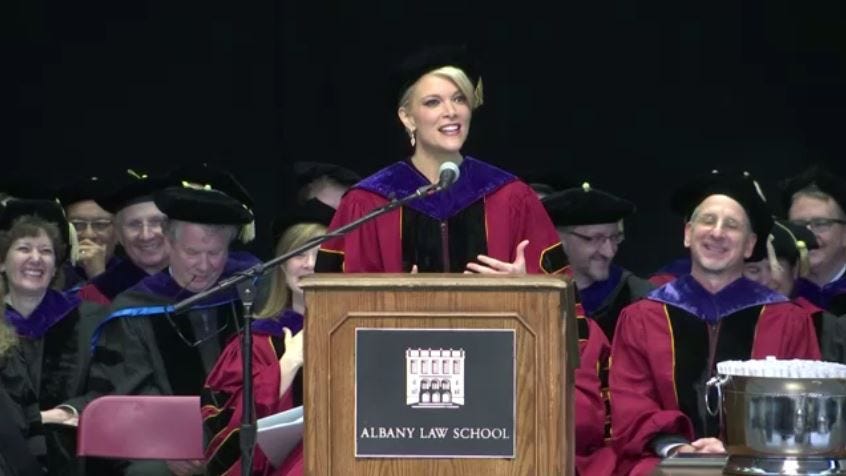
The surprising thing about Megyn Kelly is that she has a background in law, having graduated from Albany Law School in 1995, and putting eight years of corporate legal practice under her belt before transitioning into the world of television news reporting in 2003.
Maybe if Megyn had spend more time focusing on Constitutional law, she would understand just how intellectually vacuous her comments about Alex Pretti’s death were.
Megyn Kelly is a journalist. As such, she should have done some basic due diligence before publicly opining on a topic such as the murder of Alex Pretti by ICE agents. Had she done so, she would have been able to familiarize herself with the Complaint for Declaratory and Injunctive Relief filed in United States District Court for the District of Minnesota, where the plaintiffs characterize the situation in Minneapolis as “an unprecedented deployment of federal immigration enforcement agents from numerous agencies of Defendant U.S. Department of Homeland Security (‘DHS’)” that has “instilled fear among people living, working and visiting the Minneapolis-Saint Paul metro area (the ‘Twin Cities’)” due to “thousands of armed and masked DHS agents” who” have stormed the Twin Cities to conduct militarized raids and carry out dangerous, illegal, and unconstitutional stops and arrests in sensitive public places, including schools and hospitals—all under the guise of lawful immigration enforcement.”
The complaint states that the defendants “deployed over 2,000 DHS agents to the Twin Cities—a number that greatly exceeds the number of sworn police officers that Minneapolis and Saint Paul have, combined”, noting that this action “is, in essence, a federal invasion of the Twin Cities.”
In short, Alex Pretti was confronting what amounted to an illegal occupation of Minneapolis by armed federal agents that violated basic constitutional rights and protections under the 10th Amendment of the United States Constitution. “The Tenth Amendment gives the State of Minnesota and its subdivisions, including the Cities of Minneapolis and Saint Paul, inviolable sovereign authority to protect the health and wellbeing of all those who reside, work, or visit within their borders,” the Complaint for Declaratory and Injunctive Relief declares. “Being free from unlawful seizures, excessive force and retaliation are not a list of aspirations Minnesotans deserve; these are rights enshrined within state and federal laws.”
Rights that the illegal invasion and occupation of Minneapolis by ICE agents openly violate.
Rights that Alex Pretti was defending when he was murdered by ICE agents.

Oh our Minneapolis, I hear your voice
Singing through the bloody mist
We’ll take our stand for this land
And the stranger in our midst
Here in our home they killed and roamed
In the winter of ’26
We’ll remember the names of those who died
On the streets of Minneapolis
Megyn Kelly’s words and posturing reflected more than simply an ignorance of the Constitution. The ugliness of her sentiments toward Alex Pretti exposed a poisoned core of flawed humanity that had to come from somewhere prior to her time at Albany Law.
There were hints of Megyn Kelly’s internal rot early on in her television career. In 2004, Kelly was hired by Fox News after being interviewed by Roger Aisles, the chairman and CEO. As Megyn Kelly herself admits, she wasn’t hired for her talent as a journalist or for her intellect, but rather her looks, undergoing a humiliating interview process which included doing the infamous “twirl”, which another Fox News female on-air talent said was so Aisles could “see her ass.”
“So I was asked to do the spin,” Kelly later said, “and God help me, I did it. I know people think it’s like, ‘Oh, yeah, you have to spin around.’ But I remember feeling like: I put myself through school; I was offered partnership at Jones Day, one of the best law firms in the world; I argued before federal courts of appeal all over the nation; I came here, I’m covering the U.S. Supreme Court; I graduated with honors from all of my programs — and now he wants me to twirl. And I did it.”
“If you don’t get how demeaning that is,” Megyn said, “I can’t help you. In retrospect, I’d give anything if I had said ‘no.’”
But the truth is, if she had said “no”, she most likely wouldn’t have gotten the job (it should be pointed out that Megyn Kelly claims that Aisles, two years after she was hired, tried to kiss her three times, and each time she rejected his overtures. Kelly not only kept her job, but was promoted, a sign that talent, not submission, played a role in climbing the corporate ladder at Fox.)
No one should ever be placed in the position Megyn Kelly and the other female Fox News employees were placed in. There must be zero tolerance for sexual harassment, or harassment of any kind, in or out of a place of work.
But the fact remains that Megyn Kelly was hired because she fit a certain profile, physical, emotional, and intellectual.
Roger Aisle’s may have hired her in part because of her ass.
But he also hired her because she was white, with blonde hair and blue eyes, with an emotional and intellectual disposition that was appealing to the conservative Fox audience.
What exactly this emotional and intellectual disposition represented emerged in time.

Trump’s federal thugs beat up on
His face and his chest
Then we heard the gunshots
And Alex Pretti lay in the snow, dead
Their claim was self defense, sir
Just don’t believe your eyes
It’s our blood and bones
And these whistles and phones
Against Miller and Noem’s dirty lies
During an on-air segment that aired on December 12, 2013, Megyn Kelly and her co-panelists were discussing a piece in Slate written by Aisha Harris about a black versus white Santa. Kelly noted that the author was arguing that “Santa Claus should not be a white man anymore. And when I saw this headline,” Kelly continued, “I kind of laughed and thought, yeah, this is so ridiculous, yet another person claiming its racist to have a white Santa and, you know…and by the way, for all you kids watching at home, Santa just is white. but this person is just arguing that maybe we should also have a black Santa, but Santa is what he is, and were just debating it because someone wrote about it, kids.”
Megyn Kelly continued. “The author…she’s African American, and she seems to have real pain having grown up with this image of a white Santa. You know, I’ve given her her due. Just because it makes you feel uncomfortable doesn’t mean it has to change,” Kelly said. “Jesus was a white man, too. It’s like we have, he’s a historical figure that’s a verifiable fact, as is Santa, I just want kids to know that. How do you revise it in the middle of the legacy in the story and change Santa from white to black?”
Megyn Kelly’s comments ignited a media firestorm, as many well-known media personalities lashed out at the blatant racism of her comments. Two days after making her “Santa is white” statements, Megyn Kelly returned on hair and doubled down on her position. “Apparently we ignited quite a controversy the other night,” Kelly said in her opening remarks on The Kelly File. “Humor is a part of what we try to bring to this show but sometimes that is lost on the humorless.” Kelly then played a compilation of clips showing her critics, including Jimmy Kimmel, Chris Hayes, and Don Lemon, reacting to her comments.
“This would be funny if it were not so telling about our society,” Kelly said, accusing the critics of having a “kneejerk reaction to race bait.” Kelly said her comments weren’t “motivated by any racial fear,” Kelly proceeded to defend her argument that Santa is white, citing the movie Miracle on 34th Street and the Macy’s Thanksgiving Day parade. The blonde haired, blue eyed television host did, however, concede she might be wrong about the color of Jesus’ skin. “As I’ve learned in the past two days, that is far from settled,” Kelly admitted.
In September 2017 Megyn Kelly was hired by NBC for a high profile role on their flagship “Today” program. She was interviewed by Business Insider on November 29, 2017, where she was specifically asked whether she still believed Santa was white.
Megyn Kelly acknowledged that she “regretted a lot” of what she said while working for Fox, explaining that “if you’re going to be on the air on live television, you’re going to say stupid shit. That’s just a reality, so yeah, there’s a lot I’d like to go back and say differently.”
Megyn Kelly then proceeded not to answer the question, but rather play the victim card. “I think the lens is a truth teller, and people who watch you day after day will see who you are without the caricature of you that’s put out there by web sites and so on drooling over you One of my great struggles at Fox was that I felt that everything I did was viewed through a negative prism by those who didn’t like Fox or what it stands for, and I hated that. And I really hope that in my new position people will just see me for who I am and not through that prism. So far I feel like it’s happening. But I feel like time will tell. You’ll see me and you’ll figure out who I am, and people will accept or not accept based upon what they see, and that’s all I can ask of everybody.”
Oh our Minneapolis, I hear your voice
Crying through the bloody mist
We’ll remember the names of those who died
On the streets of Minneapolis
And watch her they did.
Little more than a year after NBC hired Megyn Kelly, she revealed her true self for all the world to see.
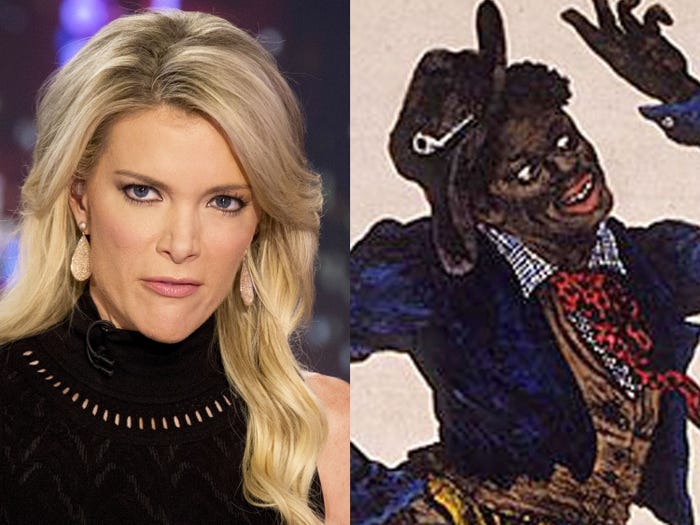
In a segment that aired on October 23, 2018, about political correctness and Halloween costumes, Kelly raised the issue of “blackface”, a practice dating back to the infamous minstrel shows popular in New York during the 1830’s, where white performers blackened their faces with faces burnt cork or shoe polish and, wearing tattered clothing, portrayed enslaved Africans on Southern plantations as being lazy, ignorant, and prone to thievery and cowardice.
“But what is racist?” Kelly asked. “Because you do get in trouble if you are a white person who puts on blackface on Halloween, or a black person who puts on whiteface for Halloween. Back when I was a kid that was OK, as long as you were dressing up as, like, a character.”
Later in the discussion, Kelly brought up Luann de Lesseps, a star on The Real Housewives of New York who drew a backlash in 2017 for dressing up as Ross.
“There was a controversy on The Real Housewives of New York with Luann, and she dressed as Diana Ross, and she made her skin look darker than it really is and people said that that was racist,” Kelly said. “And I don’t know, I felt like who doesn’t love Diana Ross? She wants to look like Diana Ross for one day. I don’t know how, like, that got racist on Halloween.”
America saw Megyn Kelly. America figured out who Megyn Kelly was.
And we rejected her as a racist.
Two days later Megyn Kelly was back on air, this time to deliver an apology. “I’m Megyn Kelly,” she began, “and I want to begin with two words: I’m sorry.”
With her voice cracking and her blue eyes brimming with tears, Kelly continued.
“You may have heard that yesterday we had a discussion here about political correctness and Halloween costumes. And that conversation turned to whether it is ok for a person of one race to dress up as another—a black person making their face whiter or a white person, darker, to make their costume complete. I said it seemed ok because it was part of a costume. But I was wrong, and I’m sorry. One of the great parts of getting to sit in this chair is getting to discuss points of view. Sometimes I talk, and sometimes I listen. Yesterday I learned. I learned that the history of blackface being used in awful ways by racists in this country. It is not ok for that to be part of any costume, Halloween or otherwise. I have never been a PC (i.e., politically correct) kind of person. But I do understand the value in being sensitive to our history, particularly on race and ethnicity.”
“I believe this is a time for more understanding, more love, more sensitivity and honor,” Kelly concluded. “And I want to be part of that. Thank you for listening, and for helping me listen, too.”
Megyn Kelly’s apology was too little, too late. The next day NBC terminated her show, Megyn Kelly Today. Her contact was terminated on January 18, 2019.
In her apology, Megyn Kelly talked about “learning” the history of blackface in America. As the National Museum of African American History and Culture notes on its webpage dedicated to the issue of Blackface, “Minstrelsy, comedic performances of ‘blackness’ by whites in exaggerated costumes and make-up, cannot be separated fully from the racial derision and stereotyping at its core. By distorting the features and culture of African Americans—including their looks, language, dance, deportment, and character—white Americans were able to codify whiteness across class and geopolitical lines as its antithesis.”
White Americans putting on blackface to denigrate and demean Black Americans in order to codify White superiority as a societal norm.
And yet, Megyn Kelly chose in her apology to talk about Black Americans putting on whiteface as the lead example, thereby giving something that simply never happened moral equivalency with blackface, something that did happen.
Megyn Kelly didn’t listen, and she didn’t learn.
She had been exposed as a racist, and was compelled to deliver an apology for her actions, something she didn’t really deliver on.
According to the National Museum of African American History and Culture, “blackface” was invented by poor and working-class whites who felt squeezed politically, economically, and socially “as a way of expressing the oppression that marked being members of the majority, but outside of the white norm.”
Blackface was a racist coping mechanism designed by White people to better cope with the same societal rejection that black people felt. Blackface was the poor white man’s way of feeling better at the expense of black people.
“Blackface” is a fundamental part of who and what Megyn Kelly is: an American racist.

Now they say they’re here to uphold the law
But they trample on our rights
If your skin is black or brown my friend
You can be questioned or deported on sight
In chants of ICE out now
Our city’s heart and soul persists
Through broken glass and bloody tears
On the streets of Minneapolis
When discussing blackface, Megyn Kelly noted that “Back when I was a kid that was ok, as long as you were dressing up as, like, a character.”
The roots of Megyn Kelly’s racism, therefore, can be traced to her childhood. Megyn Kelly moved to the Hamlet of Delmar, New York when she was nine years old. She was a product of the Bethlehem School District (the Hamlet of Delmar is one of five Hamlets which comprise the Town of Bethlehem), and graduated from Bethlehem Central High School in 1988.
When Megyn Kelly made her blackface comments, the students of Bethlehem High School spoke up to make sure Megyn Kelly and American understood that Kelly’s words did not reflect the beliefs of the student body of Kelly’s alma mater. “Megyn Kelly has walked our halls and strolled our streets; she's a proud member of our high school’s hall of fame, and her work has put our hometown of Bethlehem, New York, on the map,” a group of known as Students for Peace and Survival at Bethlehem Central High School wrote in an open letter. “But, as a group of young people of all different races, political beliefs and cultural backgrounds nonetheless united in fighting for a better future through a student club in her own high school, some of her recent comments have concerned us, and we hope that she hears us.”
Megyn Kelly’s comments, the students declared, “definitely do not speak to who we are in Bethlehem or at Bethlehem Central High School, from which she graduated in 1988. Blackface is not acceptable anywhere in America, and it is not acceptable in our town. We weren't alive when Megyn was in high school but, in the recollection of many of our parents who grew up around here, it was not acceptable even in the 1980s town that she knew.”
The students then proceeded to give Megyn Kelly a history lesson about blackface and Delmar. Blackface, the students noted, “was part of a broad and sordid tradition of masking racism in the ‘humor’ of minstrelsy; people who lived in our area were not immune. Our local newspaper’s records show that minstrel shows were performed as fundraisers in our elementary school gym as late as 1960 (albeit a decade before Megyn was born). Perhaps its staying power even in the northeastern United States despite its obvious bigotry speaks to the pernicious role that blackface played and still plays in broadly normalizing racist caricatures. Jim Crow, after all, was a blackface character long before he was shorthand for systematic oppression.”
The Bethlehem students continued: “Racism might have become more subtle in the intervening years, but it remains just as potent a force in the society into which we’re about to enter as adults. The reason that Megyn’s comments about blackface being ‘OK’ when she was a kid (let alone her statement at the time that ‘I don’t know how [blackface] got racist on Halloween,’ in response to prior critics of the practice) were so offensive is that blackface is a projection of the racism that lies much deeper, and a symbol of times that are not quite as far past as we may wish to admit. As young people, we know that racial stereotyping and institutional discrimination hurts all of our futures. On race and so many other issues, our generation is waking up to a world in need of fixing — and it’s falling on us to make change happen.”
“We all have times when we use words poorly,” the students wrote, “just ask our English teachers. We cannot judge each other by our worst moments, and believe Megyn when she says that her recent comments do not speak to who she is. We know full well that one of the hardest things to do is to apologize, and we thank her for doing so. But retroactively showing ‘sensitivity’ isn’t nearly enough to prevent the cycle from continuing.”
“We must go further,” the students declared. “The solution is not sweeping these uncomfortable ideas under the rug; it’s facing them head on with appreciation for their context.”
“With more diversity of all types — on both sides of the camera — Megyn’s employer, NBC News, could approach these difficult topics with the care they deserve. By allowing America to hear the stories of those who have suffered from stereotyping and institutional racism,” the students observed, “she and they could spur important conversations. Her words carry weight like few others with those who most need to hear these stories, and whatever happens, she still has a platform that few possess. Whatever her journalistic future brings, we hope she uses it to make a real difference and bring ‘more understanding, love, sensitivity and honor’ to these issues in the future, as she promised in her apology to do.”
“There is often an idea today,” the students concluded, “that young people like us are apathetic, brainwashed into certain ideals by those above us and too disengaged to make a difference. Nothing could be further from the truth. We’re speaking for ourselves here, as our own small part in the conversation America needs to have. If there’s one thing about our generation, it’s that we do not accept the status quo. Perhaps it’s naïveté, but in a society still bearing the scars of the times of blackface, a little bit of the innocence of hope might be necessary.”
When I first read this letter, my heart swelled with pride. These kids were seven years removed from my daughters, who graduated from Bethlehem High School in 2011. I knew my daughter’s and their friends, their hearts, their thoughts, their dreams, and their aspirations. They were the “next generation” that was going to fix the mistakes they inherited from their parents.
These kids were cut from the same cloth.
They made me proud to be a resident of Delmar, proof positive that the taxes I paid for their education were not in vain.
NBC fired Megyn Kelly.
The platform Megyn Kelly was never used to correct her mistakes by shining a light on the reality of racism.
And, as Megyn Kelly’s comments about Alex Pretti demonstrates, her pledge to bring “more understanding, love, sensitivity and honor” was just another empty promise, words uttered in desperation in a vain effort to save her job.
Megyn Kelly betrayed these students, just as she betrayed Fox News, NBC, and the American people.
Just as she betrayed Alex Pretti.

Oh our Minneapolis, I hear your voice
Singing through the bloody mist
Here in our home they killed and roamed
In the winter of ’26
We’ll take our stand for this land
And the stranger in our midst
The roots of racism are right before our eyes.
We just have to know where to look, and the courage to see.
My family moved to Delmar, New York, in July 2000. It was a difficult move for us, because the town where we had be living—Hasting-on-Hudson—which had had been home for the past five years was a wonderful place to live, close to the excitement of New York City while retaining a quiet small-town vide, and possessing one of the best school districts in the State of New York. But economics drives decisions, and I had promised my wife that we would become homeowners once we had children of school age. We rented a house in Hastings, paying the equivalent of most mortgages for the privilege of living where we did. But when we looked into buying a 3-bedroom home in Hastings (my wife’s parents, who were refugees from the civil war in Abkhazia, Georgia, lived with us), the cost of the home combined with the associated property tax made the dream of home ownership there impossible.
My wife was insistent that we remain close to the city where our children were born (Mount Sinai Hospital is in Manhattan), so we drew a circle around the Big Apple representing a three-hour drive, and started doing our research.
The Hamlet of Delmar, New York, came out on top.
We purchased a four-bedroom two story home for less than 1/3 the cost of a three-bedroom home in Hastings. The property taxes in Delmar were 1/4 those in Hastings. Economically, the decision was a no brainer.
In 2000, the population of Delmar was 8,292, with a population density of 1,892 per square mile, more than half that of Hastings. There were 3,501 housing units, creating a density of 799 per square mile, again more than half that of Hastings.
The similarities continued when it came to demographics. In Delmar 33.3% of the households had children under the age of 18 living with them, and 60.0% of the households were comprised of married couples residing together. In Hastings these numbers were 33.8% and 57%, respectively. The median household income in Delmar was $83,219, and in Hastings, $129,227 (the difference is reflective of the proximity of New York City to Hastings, and the higher costs of living.) In both places, the percentage of residents under the age of 18 was around 25%.
These are important numbers, since income and families and children all factor into the quality of a school district, which is paramount for a family with school-age children. The Hastings-on-Hudson School District was one of the best in the State of New York.
The Bethlehem School District was even better.
There were some other similar identifying characteristics as well. The percentage of residents in Hastings who were white was 86.8%, with Blacks comprising 2.9%. In Delmar, 96.61% of the residents were white, and 1.18% Black.
I bring this up because in both Hastings and Delmar, the schools my daughters attended were nearly Lilly white in terms of their racial composition. Shortly after we moved to Delmar, I took my daughters with me while dropping off clothes for the Salvation Army. The drop-off point was located in the Arbor Hill neighborhood of the City of Albany, where 81% of the population was Black. Many of the homes in the neighborhood were boarded up, burned out, or in a general state of disrepair. Garbage was uncollected on the streets. My daughters were shocked by what they saw, and even more shocked by the concentration of Black people in the Arbor Hill neighborhood. They asked the questions one would hope they would ask—why the disparity of conditions, and why were there so many Blacks in Albany, and so few Blacks in Delmar?
I didn’t have the answers, but I promised them we would find the answers out together.
What I found was an indictment of our nation.
During the time of the Great Depression (1929-1939) housing construction collapsed. One of President Franklin Roosevelt’s top priorities was jump-starting housing construction, and in 1934 he set up the Federal Housing Administration (FHA), which ostensibly guaranteed bank mortgages intended to reinvigorate the housing construction industry, and as a result, increase the rate of home ownership.
But there was a catch—Blacks didn’t qualify.
One of the ways the FHA denied Black Americans access to these guaranteed mortgages was through what was known as “redlining”—an evaluation and subsequent evaluation of neighborhoods based upon desirability and riskiness. “Green” areas were “good”, and “Red” areas were “bad.”
In 1938 FHA agents, working collaboration with local bankers and realtors, drew up a “redlining” map for Albany. Neighborhoods where Blacks lived were universally categorized as “Red”.
“Redlining” remained in force until the 1970’s, when it was deemed illegal. But by then the damage was done—income disparity was hard-wired, with the household wealth of a typical white family ($171,000) being ten times that of a typical African American family ($17,150).
A major causal factor for this disparity was the fact that Blacks had been denied the same rights as Whites when it came to home ownership. “Redlining” encouraged poverty, and poverty beget crime.
The Arbor Hill neighborhood in Albany was a byproduct of “redlining” and, as my daughters witnessed first hand, was still haunted by the consequences of this policy decades after it was officially terminated.
Delmar never had an official “redlining” policy.
But it “redlined” nonetheless, using different tactics.
In 2005, CNN/Money Magazine named Delmar as a “Great American Town”, rating it as the 22nd “Best Places to Live” in America.
The entire Hamlet was, in effect, a “Green” zone for housing development.
Delmar was designed from scratch to be a haven for White people.
Delmar was, and is, the manifestation of how America hides its racism right before our very eyes.

We’ll remember the names of those who died
On the streets of Minneapolis
We’ll remember the names of those who died
On the streets of Minneapolis
I joined the Delmar Fire Department in the Summer of 2001, before 9/11 made firefighting “cool.”
I did it to serve my community and, if I’m entirely honest, to feed my need for the adrenaline that had been lacking in my life since I resigned as a weapons inspector in Iraq.
Firefighters have an intimate understanding of the community they live in and serve, especially one like Delmar, where the department combined fire and EMS response.
You get to see the community as it grows, conducting building construction surveys to understand the layout and materials used so the proper decisions could be made if the place ever caught on fire.
You got to see the community at its best during open-house events designed to encourage bonding between the department and the residents of Delmar.
And you got to see the community at its worst, responding to the myriad of emergencies that any community suffers during a calendar year. We responded to between 300-400 fire calls per years, and between 1,600-2,000 EMS calls.
Most of them were routine; many were not.
Almost every fire/EMS call put us in contact with the Bethlehem Police Department.
Early on in my time with Delmar Fire, I sensed that something was wrong. One of the fire officers whom I had grown close with was a cop in a neighboring town. He often regaled us with stories drawn from his experiences on duty—the stupidity of the criminals he arrested, and some of the more adventurous encounters. It took me a moment to realize that in every case the perpetrators he was describing were black men. One of the reasons it took me so long was that he and the others were speaking in code. “Fucking Mondays”, he would say, with everyone else shaking their heads in agreement.
After hearing him say this repeatedly, I finally spoke up. “The arrest took place Friday,” I said. “Why are you speaking about Monday?”
He looked at me, raised an eyebrow, and then looked at the rest of the firefighters, and they all broke out laughing.
“We’re not allowed to use certain words any more,” he said. “Instead of the ‘N’ word, we just call them Mondays.”
“Why ‘Mondays’?” I asked.
“Because Mondays suck.”
When the decision was made by the Bethlehem Town Board to build a Walmart Super Store in the Glenmont neighborhood next to Delmar, the Bethlehem cops protested. “Every fucking day is going to be Monday”, they said, commenting on the fact that the City of Albany was going to open up a bus route that would bring city residents to the new store.
“They’re fucking thieves. We will be spending all our time responding to shoplifting calls,” the cops complained.
The Bethlehem police department had an unwritten rule to keep “Mondays” out of the town. They patrolled the bridge over the Normans kill River that connected Albany with Bethlehem, stopping any black person who sought to walk across to inquire about what their business was in Bethlehem. “We can’t stop ‘em,” the cops said. “But we can let them know their not welcome, and that we have our eyes on them.”
When I was a Lieutenant I responded to calls out of Station Two, the “Black Sheep.” Historically Station Two was difficult to staff, since it was located far from the town center where most of the volunteers lived. But I was blessed with some great volunteers who shared my work ethic, and over time I built up a sense of esprit among my fellow “Black Sheep”; we not only started getting out of the station ahead of the Station One apparatus, but because we were getting more action, we trained hard, and were the first choice of the neighboring fire districts when it came to mutual aid.
Working with my “Black Sheep”, it became readily apparent that the racism I had witnessed extended to a general prejudice against anyone who wasn’t a straight white Christian male.
We had a great husband and wife team—he was a lawyer, she was an emergency room nurse. They took their duties seriously, attending advanced training courses and were a large part of the reason we got out of the Station as fast as we did.
During an arson investigation class, a local cop who also served as a Chief in a neighboring fire district was giving a lecture in which he referred to the act of arson as “Jewish Lightning.”
The lawyer and his wife were Jewish.
I raised my hand and asked if that was an appropriate term to be using. The cop looked at me like I was crazy. “That’s just what we call it,” he said, “The term comes from Brooklyn. Everyone uses it. We don’t mean any harm.”
The lawyer and his wife resigned shortly afterwards.
We had a great female volunteer. She was petite as hell, and I worried about her being able to perform all the tasks necessary—especially those requiring upper body strength. To qualify as an interior firefighter, each firefighter had to be able to perform a series of tasks under live fire conditions. One of these tasks was to advance a charged 2 1/2 inch down into a basement, fight the fire, and then pull an “injured” firefighter out of the basement.
I was the “injured” firefighter.
This gal muscled the 2 1/2 inch line down the stairs, using techniques I taught her that reduced the amount of upper body muscle work required. When it came time to pull me out, she did the job, step by step. She took a bad fall, but got up and persevered. When it was done, I looked at her mask and noticed there was blood inside. She had broken her nose and cut her mouth, and she needed medical attention.
But she never quit.
I took her onboard the “Black Sheep.”
But she was a lesbian.
And the rest of the fire department made fun of her behind her back.
She eventually resigned.
We had a professional firefighter from the City of Kingston move to Delmar so he could be closer to his girlfriend.
He was black.
She was white.
This guy was good, and I got him assigned to Station Two.
I had him walk through my engine set up, looking at how we packed our hoses, and discussed tactics and ways to be more efficient in our duties. His advise proved invaluable—during one response to the nearby Corning Factory, where a fiberglass production unit had caught fire, his innovation enabled us to stretch a primary and backup line and initiate attack within a few minutes of our arrival.
But Mondays suck.
Especially if they have attractive white girl friends.
The whisper campaign waged behind his back was relentless.
He resigned and moved back to Kingston.
The firefighters of the Delmar Fire Department were as dedicated a group of citizens as one could hope for.
They responded to the emergency calls for help from their fellow citizens at all hours of the day, seven days a week, 52 weeks a years.
We fought fires, mitigated floods, and saved lives.
Most of the members were Megyn Kelly’s age.
Many of them knew her when she attended Bethlehem High School.
Her faults were their faults.
They were all the product of a community designed from the ground up to be racist and discriminatory.
A place where Monday’s sucked.
And Monday’s weren’t just blacks, but anyone of color, or someone whose religion didn’t fit the Christian norm, or who’s sexual orientation wasn’t straight and white.
Yes, Delmar is one of the best places to live in America.
It’s also one of the most racist, discriminatory places to live in America.
Yesterday ICE agents raided a home in Clifton Park, detaining a family of five, including three school-aged children who attended the local schools.
The ICE agents entered the home without a warrant signed by a Judge, instead relying on an administrative warrant, making the raid a direct violation of the 4th Amendment of the United States Constitution.
This raid wasn’t an isolated act, but rather part of a deliberate policy being implemented by the Department of Homeland Security where ICE agents are told to ignore the training they received about need for judicial warrants, and to act solely on an administrative warrant signed off by their superior officer.
At some point Americans will need to decide where they are willing to draw the line when comes to defending their Constitutional rights.
Here in Lilly White Upstate New York, there is a deafening silence about what ICE has done, and what ICE is doing.
We could use a few Americans like Alex Pretti and Renee Good to assemble in the streets, cell phone cameras in hand and whistle in their mouths.
Fighting for the rights so many of their fellow citizens sacrificed their lives to defend.
And now Alex Pretti and Renee Good’s name are carved into this Pantheon of heroes.
Who will pick up their banner and lead the charge? Who among us has the courage of conviction to defend the one thing that defines who we are collectively as a nation?
The Students for Peace and Survival at Bethlehem had appealed to Megyn Kelly back in 2018 to use her platform to promote the kind of “understanding, love, sensitivity and honor” Megyn had promised to promote in the aftermath of her “blackface” scandal.
The family in Clifton Park could certainly benefit from some of the historical sensitivity toward race and ethnicity in America that Megyn Kelly claimed she had been imbued with after “learning” about racism in America.
Instead, Megyn Kelly is once again on the wrong side of history, openly mocking the death of Alex Pretti.
Alex’s crime was to stand up for the right’s of those less fortunate that him.
Of those who did not share his ethnicity.
Those who did not share his citizenship.
For those who had the same rights as he did.
Alex Pretti and Renee Good fought for all the Mondays of Minneapolis.
And now they are dead.
And the reason for Megyn’s silence cannot be swept under the carpet.
It is because Megyn Kelly is a product of the Town of Bethlehem, and the Lilly White Hamlet of Delmar.
And Monday’s fucking suck.
(The lyrics used in this article come from the song “The Streets of Minneapolis”, performed by Bruce Springsteen.)
If you watch Megyn's interview with Putin - the RAW interview, the entire thing, and not the edited version - you will see a psychopath. The eyes are cold and mostly devoid of expression. Like a shark's eyes.
Putin's eyes, on the other hand, are filled with emotion which he is struggling to control, using all his wisdom from his martial arts and KGB training.
I'm surprised your work draws some of the very kind of stupid racists you expose and condemn, Scott. Or perhaps they're bots, or paid plants. In any case, well done. The sad fact is that America is, and always has been, predominantly stupid racist. The difference now is that behind the vicious sickness of our detestable President, they feel able to show, in public, what they have always been in private. I don't believe this reality is reformable.