

Artificial Intelligence versus the OODA Loop
Artificial Intelligence is being hyped as a revolution in military affairs. But the old-school human decision making cycle, properly implemented, will crush AI on the modern battlefield.

Artificial Intelligence (AI) is the newest buzz phrase making its way around military circles. Some are dismissive of what they view is little more than a gimmick. Others treat AI as if it represented a revolution in military affairs. But the fact is few understand what AI means from the perspective of warfare, and as such are ill-prepared to discuss it in any meaningful fashion.
What is AI? The textbook definition is “the application of computer systems able to perform tasks or produce output normally requiring human intelligence, especially by applying machine learning techniques to large collections of data”—in short, computerized thinking.
Before we get too far carried away here, let’s be clear—computers cannot “think”, nor are they capable of human-like reasoning.
A computer can be programmed, that’s it. And one of the programs a computer can be programmed to run is to modify its own program by adapting patterns detected while processing data in accordance with structured algorithms that then can be cast as “analysis.”
But a computer does not “analyze” anything. It simply subjects a given data set to a series of preprogrammed processes that mimic the structure of analysis without truly being able to discern actual meaning—a prerequisite for true analysis.
Meaning is a uniquely human trait, defined as is thing one intends to convey especially by language.
The key word here is intends, meaning to have in mind a purpose or goal. Purpose means the reason for which something is done or created or for which something exists.
A computer cannot reason (i.e., the power of the mind to think, understand, and form judgments by a process of logic), and therefore cannot have a purpose, and as such lacks intent, and with it, meaning.
A computer simply does what it is programmed to do.
The major mistake, therefore, when it comes to assessing the role AI plays in determining the nature of warfare today is giving the computer human-like qualities, which leads to an overreliance upon the data produced as part of any AI process.
It is just data that was generated by a program prepared by humans—fallible humans. The output is, logically, not infallible.
It is not the byproduct of any self-aware intelligent processing of data.
Now the proponents of AI will claim that they have mastered certain algorithmic-driven data processing programs in such a way that allows for more data to be assessed using pre-determined structured “logic”, providing potential users with more options on how to interpret the data in a timeframe that is exponentially faster than that which could be achieved using old-school human analytical techniques.
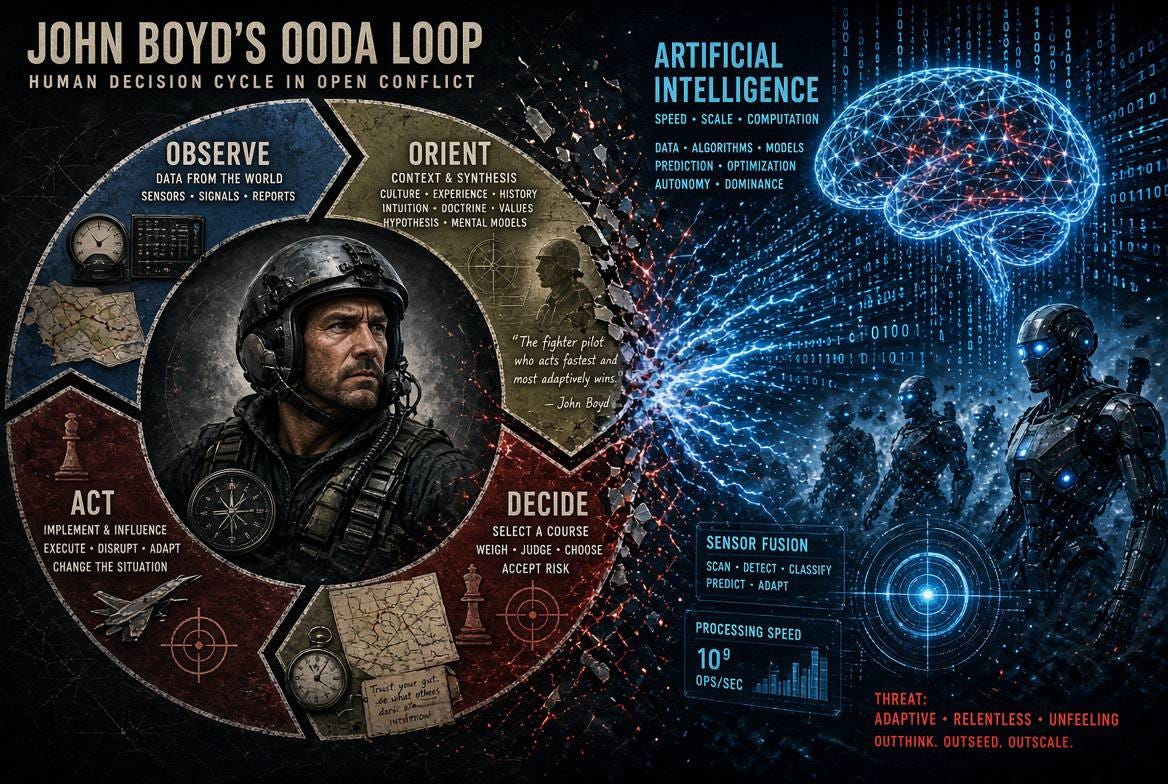
When one looks at the basic principles of decision-making during wartime, John Boyd’s classic “OODA-loop”, comes to mind. Boyd was a US Air Force fighter pilot known for his ability to shoot down (in training) any opposing pilot within 40 seconds of their initial pass. Boyd went on to distill the decision making processes involved in his actions into what he called the OODA Loop.
The popular perception of the OODA Loop is a circular thought process involving four sequential steps: Observe, Orient, Decide, Act, which are then repeated.
The loop begins with the act of Observation—to observe. This involves absorbing information—data—from the environment one is operating in. Many believe this represents a passive act, but it is anything but. To truly observe one must constantly be taking in information from the operating environment, inclusive of that data derived from unfolding (i.e., unprogrammed) circumstances, and one’s interaction with the various processes. It is a uniquely individual proposition—two people can observe the same thing and yet interpret it in completely different ways.
The key to observation is orientation. Boyd viewed observation as the intellectual center of gravity of the OODA loop. Orientation is a decidedly individual trait, considering as it does the shared assumptions of an organization as it relates to innate cognitive tendencies and temperament of the individual, past experiences (organizational and individual), the ability to collect new data based upon the current situation, and the ability to disregard old mental models while constructing new ones.
Orientation determines the quality of everything that follows. Two analysts examining the same data will inevitably reach different conclusions depending on their experience, their assumptions, and how willing they are to update their mental models.
One cannot “teach” a computer how to orient—the computer will simply be programmed based upon the experience of the programmer and the assumptions the programmer builds into the model. The computer becomes a prisoner of this model, unable to disregard it for a new model constructed upon newly observed data sets.
This shortfall manifests itself in the next step of the OODA loop—decide.
Decisions are made based upon hypothesis or plans of action that arise from observation. But John Boyd didn’t view decision-making as a closed loop process. Indeed, in his original diagram of the OODA loop, Boyd drew a line directly from Orient to Act, bypassing Decide entirely. Boyd called this “Implicit Guidance and Control” (IG&C), something that arises when someone possesses deep expertise that permits rapid pattern recognition and the ability to act upon it without conscious deliberation. When someone has deep expertise in a domain, they can recognize a pattern and act on it without conscious deliberation; in short, trained intuition flowing from deep orientation.
You cannot program a computer to behave in this way.
Act is the most basic element of the OODA loop, the process of testing a derived hypothesis against reality. Action will inevitably generate new information which will then be fed back into the observation cycle, and the loop repeats itself.
Someone unfamiliar with the reality of Boyd’s OODA loop theory would program a computer to process the loop as a clean sequence—observe, orient, decide, and act, and then repeat,
But the true OODA loop operates in multiple directions simultaneously, with orientation shaping observation, and action generating new observations, some of which can be acted upon without going through a formal decision-making process. A fully functioning OODA loop operates in a continuous and overlapping manner and is not sequential. It also centers on the act of orientation—the ability to ascertain patterns one’s enemy has not recognized, and then acting in ways that generates confusion by behaving in ways the enemy’s mental model could not predict.
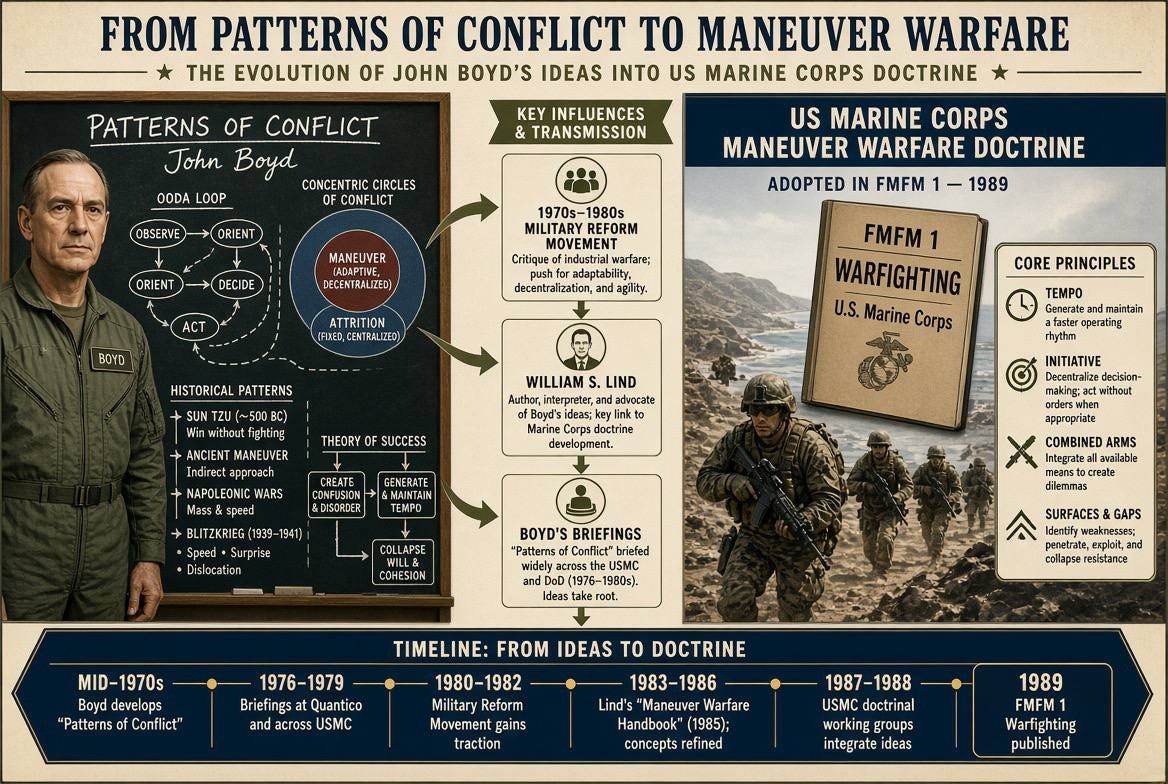
The US Marine Corps incorporated John Boyd’s “Patterns of Conflict” briefing (a 196-slide presentation assembled in 1976) which followed the history of conflict, developing patterns of behavior that translated into modern times. General Al Gray, the Marine Corps Commandant from 1987 through 1991, took Boyd’s briefing and transformed it into operational principles known as Maneuver Warfare, which became official Marine Corps doctrine in 1989. Gray emphasized the principle of commander’s intent, and the ability of subordinated units to act based upon commander’s intent without checking back into the loop for approval. The Marine Corps model of Maneuver Warfare was the ideal weaponization of the IG&C aspect of the OODA Loop, where an organization and its component parts were so finely attuned to each other as to collapse the OODA loop into an observe-act sequence that enabled the Marines to make battlefield decisions in a manner which far outstripped their opponent’s ability to respond.
I was a direct byproduct of the Marine Corps’ embrace of Maneuver Warfare, having been schooled upon it in 1984 when it was first formally introduced into the training cycle of Marine Corps officers.
I firmly believe that a military organization properly indoctrinated into the principles of John Boyd’s OODA loop will outperform an organization which has an over-reliance upon AI-driven data processing.
In short, the process is far more important than the data, since the only data that counts is that produced by the process itself.
Organizations like Palantir like to portray their ability to process massive quantities of data in a timely fashion as representing a radical new development in warfare.
But the reality is that computer-driven data processing cannot replicate the analytical processes associated with observations made by adequately oriented individuals. The AI will provide data summaries derived from algorithms which, because they have been pre-programmed, lack the ability to break mental models and adopt new models obtained from new data sets.
Nor can a computer be programmed to implement the IG&C ‘collapse” of the OODA loop into a simple observe-act sequence.
In modern warfare, an adequate human opponent would be able to exploit AI in a manner which led to the AI-guided party being defeated.
Any party that treated AI as anything more than a data processing tool by using AI to influence military decision making would be setting themselves up for failure when fighting an opponent fully conversant in the intricacies of Boyd’s OODA loop.
The concept of Information superiority is an intellectual trap derived from the notion that AI can collect and process data faster than humans.
There are benefits to being able to process information more rapidly than your opponent, of this there can be no doubt.
By AI doesn’t “process” information in a manner conducive to adequate functioning of the OODA loop. At best, AI summarizes data using algorithms written before the data is captured. The algorithm drives the summaries, not the data itself.
The key to information superiority isn’t the quantity of data being processed, but the adequacy of the quality of the analysis being conducted on the data most relevant to the immediacy of the military decision being made. The most important information to any given task is that derived because of actions taking place at the time of the decision being made.
AI’s ability to collect and summarize massive quantities of data becomes a behavioral characteristic which results in the construct of a discernable pattern which then drives both the orientation and observe aspects of the OODA loop. Data sets can be easily manipulated to achieve a desired result, enabling a competent opponent to confuse the AI into producing predictable outcomes which can lead to defeat.
This applies to information operations and psychological warfare as much as it does to classic military maneuvers.
AI represents the greatest danger to the practitioner of modern warfare. It makes the user intellectually weak, as it encourages mental subordination to an algorithm, and as such a lack of flexibility when it comes to dropping existing mental models in favor of newly developed models. The OODA loop is most effective when wielded by a well-trained human mind capable of discerning patterns based upon adequate orientation to the task at hand. While one might believe that AI would be able to perform a similar function, this simply is not the case.
Words like meaning, intent, purpose, and reason all have meanings that are exclusively linked to the human condition, and not able to be replicated by any computer program or algorithm.
The greatest opportunity afforded by AI, therefore, is the recognition that it cannot replace humans when it comes to decisions regarding the military tasks associated with international peace, military strategy, and global security. The sooner AI is removed from critical decision-making processes, the better.

Current events are replete with examples of the failures associated with an over-reliance upon AI. Israel has paved the way with the integration of AI programs into every aspect of the so-called “kill chain” associated with its genocidal behaviors regarding Gaza and the Palestinian civilians living there. One AI program—Lavender—is used to identify a target for destruction. Another AI program—Gospel—is used to locate the target in question, and a third—Fire Factory—helps pick to specific weapon that would be used to neutralize—kill—the target. But the most disturbing AI program used by Israel is the one called “Where’s Daddy”, which determines when an identified target has returned home, enabling Israel to strike and kill the entire family associated with the target.
The AI-directed “kill chain” used by Israel in Gaza has resulted in tens of thousands of deaths.
It has not, however, enabled Israel to defeat Hamas.
Not has a similar kill-chain AI model used in Lebanon enabled Israel to defeat Hezbollah.
The United States uses an AI platform named the Maven Smart System. Officials from Palantir, the company that built and programmed Maven, claim that the system can transmit targeting data to a particular weapons system with a simple click of a mouse button. Retired US Army General Christopher Donahue, who formerly commanded US forces in Europe, has likened Maven to a weapons system. But this definition is problematic, since such a classification brings with it legal requirements associated with oversight, something Palantir and their US military customers are seeking to avoid.
With good reason, too—Palantir’s Maven Smart System is currently being used to direct the military strikes being carried out on Iran by US forces. These strikes have resulted in the deaths of thousands of Iranians—including 168 school children in Minab—due to target misidentification on the part of the Maven system.
One of the reasons the US military performed so abysmally poor during the US-Iran conflict was the inadequacy of the targeting done by Maven. The US exhausted its supply of precision-guided standoff weapons striking thousands of targets nominated by the Maven AI model. Not only did the US strikes fail to reduce Iran’s ability to survive and sustain its military retaliatory capacity, but they also ended up depleting the arsenal of the United States when it came to these specific types of interceptor missiles capable of intercepting incoming Russian missiles.
In short, the US lost its war of choice with Iran, and one of the principal reasons behind this defeat was the absolute inadequacy of Maven as a target generating AI tool.
It should also be noted that General Donahue was relying upon Maven to be a tool capable of overcoming Russia’s anti-missile defenses in the Kaliningrad region.
A failure with Iran is embarrassing.
A failure with Russian over Kaliningrad could prove to be fatal.
In the nuclear age, one simply cannot leave critical decision making in the hands of an AI tool.
Maven was intended to protect American lives.
Its inadequacies have, in fact, place American lives at risk.
The United States also used AI in Afghanistan. Known as “Raven Sentry”, this program used open-source information to predict Taliban attacks with a high degree of reliability.
But Raven Sentry couldn’t forestall the defeat of the United States in Afghanistan.
Ukraine uses AI to target Russian vehicles in the Donbas region.
But this cannot change the fact that the Ukrainians are losing on the battlefield.
The Ukrainians used innovative AI prediction tools to help direct their invasion of Kursk in August 2024, predicting gaps in Russian defenses that could rapidly be exploited.
The Ukrainian invading force was eventually annihilated.
The historical data suggests that when AI is incorporated into classic military planning, it only leads to failure.
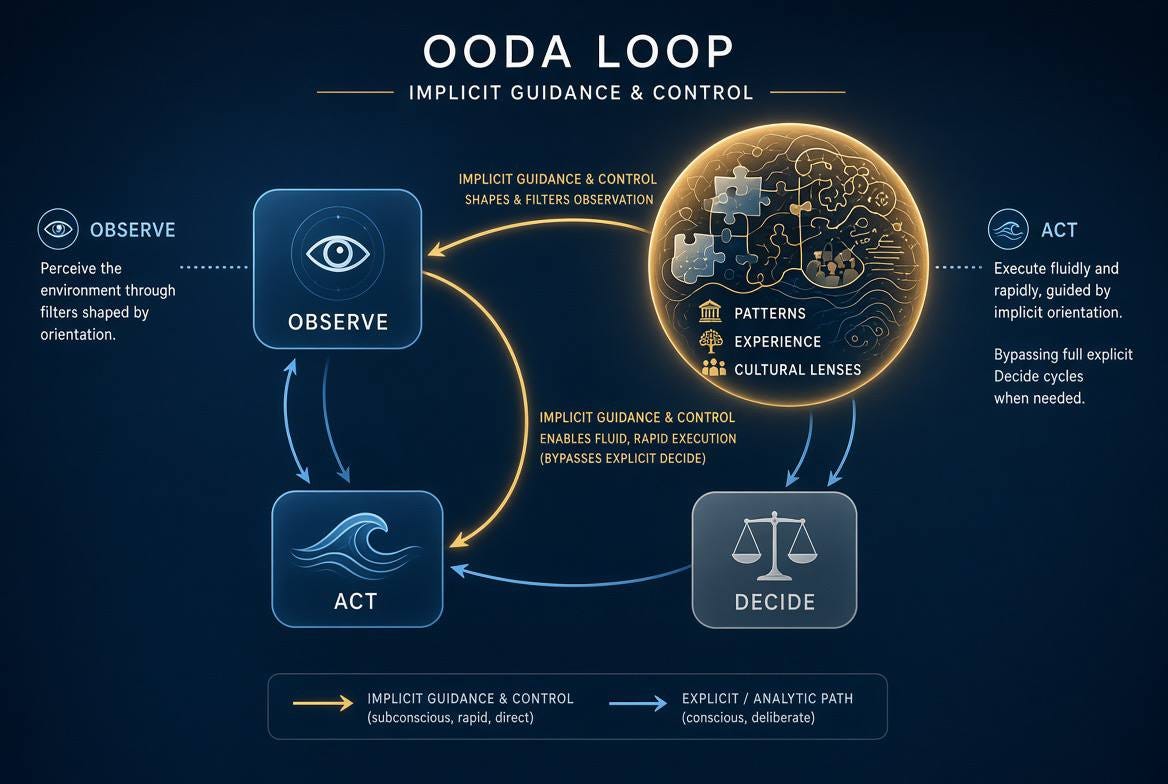
It might be time for modern military organizations to get back to the basics—develop the human aspect of war, the individual and collective brain power of their respective soldiers/sailors/airmen/Marines, so that military decision making is optimized along the lines of John Boyd’s OODA loop, at least as it was originally intended to operate. Having troops capable of adequately implementing the IG&C “collapse” of the OODA loop into a simple observe-act dynamic is far more conducive to achieving victory on the battlefield than fielding inadequate AI models.
Such training emphasizes the quality of human thought processes over the quantity of data, thereby neutering the need for AI altogether.
And if this could be done in totality, it truly would represent a revolution in military affairs.
Because in this day and age, rational human thought processes would determine that war is never the solution.
No AI program constructed to support war will ever reach that conclusion.
(This article is a free preview of the kind of analytical articles that will be published monthly as part of the paid subscription content under the “Special for Cool Guys & Gals” section of my Substack page.)
AI = Artificial Ignorance
Absolutely brilliant. Thank you.